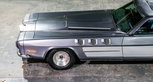
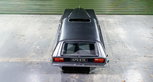
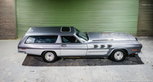
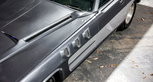
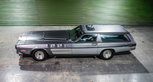
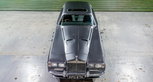
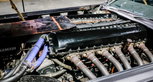
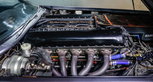


Could this be the craziest engine ever fitted to an automobile? What you see before you isn’t AI generated, some full-sized Hotwheels replica, or even a movie prop, but rather a bespoke car built to house one very special engine. The power plant in question is the Rolls-Royce Merlin engine, a formidable 27-litre V12 most commonly found in the Supermarine Spitfire and Avro Lancaster aeroplanes that fought in World War II. It sounds too insane to even border on the realm of possibility, but this incredible machine could now be yours as it heads to Historics Auctioneers’ Brooklands Velocity sale at Mercedes Benz World on November 29th. Let’s take a look at the history of the John Dodd Beast.

The Beast’s story begins not with John Dodd, but an engineer by the name of Paul Jameson. In the late 1960s, Paul was working on an entirely different, but equally crazy project in which he was attempting to construct a car chassis to house a Rolls-Royce Meteor tank engine. Jameson encountered issues when it came to finding a suitable transmission solution that wouldn’t disintegrate under the immense torque, which is when he enlisted the help of transmission specialist John Dodd, marking the beginning of a long friendship.


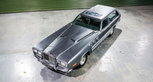
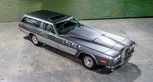
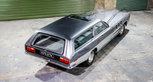
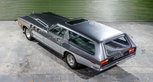
Sadly, this initial project met an untimely end when a fire destroyed the original car. Undeterred and seemingly hell bent on putting military engines in places they had never been before, John Dodd acquired the aforementioned Rolls-Royce Merlin V12, and subsequently got to work designing and engineering a bespoke heavy-duty automatic transmission that would put power to tarmac. Once the running gear was in order, Dodd contacted Fiber Glass Repairs of Bromley, a firm known for their drag racing bodies among other things, who produced the grandiose two-door shooting brake coachwork you see here.


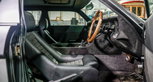
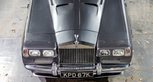
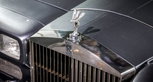
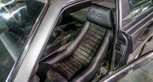
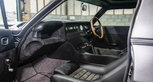
At 19 feet in length, imposing doesn’t adequately describe the Beast, which was fitted with a Rolls-Royce grille and Spirit of Ecstasy hood mascot as an ode to its 27-litre heart. Inside, the cabin was swathed in leather — Dodd wanted the Beast to be both powerful and refined — while walnut veneer was also fitted to bring it closer in line with thoroughbred Rolls-Royce models of the time. Beyond the creature comforts, the Beast was impressively engineered, boasting independent suspension and disc brakes on all four corners, while its surprisingly civilised power delivery made it shockingly usable on public roads.


With the Beast ready to be unleashed, it was time to figure out how fast this unholy matrimony of aerial engine and home-brew running gear would go. While formal testing was never conducted under controlled conditions, period reports point to a power output of between 750 and 850 horsepower, and John Dodd allegedly hit speeds in excess of 180mph on the German Autobahn. For context, the fastest supercars on the road at the time of the Beast’s completion in 1972 were only just hitting the 170mph mark, making the Beast one of the fastest road going machines of its era.

However, the Beast’s story does not end there. While the way it is presented today is as faithful as possible to its original 1972 specification, during the 1980s, Rolls-Royce took Dodd to court over the use of their mascot and grille on such an polarising vehicle. Dodd drove the Beast to court on the first day, only to break down in the centre of London — perhaps intentionally — attracting considerable attention from the press in the process. The following day, Dodd attended court on horseback, thus completing the most bizarre two car garage of all time. Perhaps unsurprisingly, Dodd lost the case, was forced to pay 10,000 pound fine, and changed the Beast’s nose. Following the court case, Dodd relocated to Malaga, Spain, with the Beast in tow. There, the thunderous roar of its 27-litre V12 became as familiar a sound as the clink of gin and tonic glasses.


Under the current custodian’s care, the Beast has seen some noteworthy changes to its appearance. The Rolls-Royce front end has been restored and the car has been wrapped in the sophisticated two-tone metallic grey livery you see today, while the original shade of light yellow remains underneath. Inside the cabin, the Beast has been treated to a comprehensive round of reupholstery, adding to its daily driver credentials (provided the next custodian is as great a character as Dodd himself). If you wish to win the day at your next cars and coffee meet, the Beast should help you earn top honours among car aficionados in perpetuity.
 city-53f1dbb1, 29 Nov