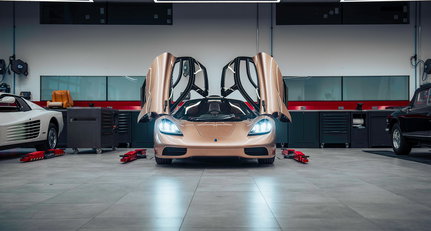



























The hypercar has become infatuated with absolute speed and virtually impossible lap times above all else. While the Ferrari F80 and McLaren W1 have traded manual gearboxes and driver engagement for those all-important milliseconds out on track, Garagisti and Co. has taken an entirely different analogue approach with their upcoming hypercar, the GP1. However, beyond the extremely rare combination of Italtecnica-built naturally-aspirated V12 engine and Xtrac six-speed manual, it’s the GP1’s gorgeous design that has us totally speechless, being both unique yet reminiscent of the iconic wedge supercars of the late 20th century. To better understand this incredible hypercar’s design, we spoke to Angel Guerra, the man who designed both the interior and exterior of the GP1, who gave us some exclusive insights into his creative process.


Angel, thank you for speaking with us. For our readers who are unfamiliar with your work, please could you give a brief overview of your background in design?
“I began working in design at Rimac in 2015, when it was a startup at the time. We were only 50 employees, so it was quite a good introduction to the world of hypercars. It helped me to understand hypercars from a holistic perspective. From 2015 to 2020, I worked on the Rimac Nevera, and since 2020, we merged with Bugatti. I worked on the Mistral, the Tourbillon, and some secret projects I can’t mention. Right now I’m working full time on my own projects and collaborating with a very specialist studio that helps with car design around the world.”

Could you name some of your automotive design heroes from the past and present?
“If I had to pick one name I would say Marcello Gandini. I feel very close to him in the way that I work. I think he was a man who wanted to stay below the radar, and only wanted to focus on design. He is by far the biggest influence on my career. I feel closer to Italian design rather than German or anywhere else, but I am from Spain and here we don’t have any major iconic designers in the automotive sector. I love all the designers from the UK and Japan, but Gandini is the best for me. The other person I will name is Walter de Silva, who everyone regards as a genius. If I had to pick someone contemporary I would pick Sasha Selipanov.”

Are there any iconic cars from the past that can be seen in the GP1’s design DNA?
“The starting point was the Lancia Stratos Zero concept by Gandini. That car defined wedge design and it’s extremely important in the history of car design as it changed everything. You can’t say the same thing about many cars nowadays. It was a car that everybody could understand - he created a new style and an icon.
“What I wanted to do with the GP1 was create a modern car that is reminiscent of the past. I wanted everyone to understand the design and for it to become instantly iconic. I took inspiration from many elements of the Zero concept and extrapolated them without copying into the GP1, with the aim of making the GP1 instantly recognisable from any angle.”

It certainly has a totally different style to any other hypercar on the market. Were there any other examples of Gandini's wedge design that influenced the GP1?
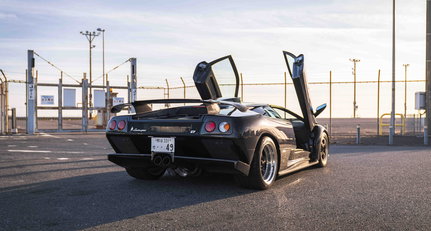
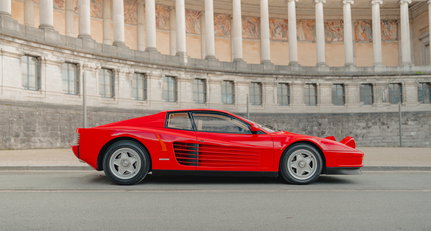
“The Countach is also one of my favourite cars, and while I didn’t want to recreate the Countach, I wanted a bit of that DNA in the GP1 - such as the design of the NACA-duct intakes. There is also a bit of McLaren F1 in terms of the size of the car, a bit of Porsche. One of my favourite cars is also the Ferrari F40, and while it didn’t directly influence any part, I kept that in mind while creating the design.”

What was the theme behind the initial concept of the car’s design?
“It was really straightforward. First I got a message from Mario Escudero, CEO and Director at Garagisti and Co., saying they wanted to do a car inspired by the great analogue icons from the 1980s, 1990s, and even the early 2000s. Above all, they wanted a return to beauty, to when fast cars were beautiful, something they felt had been lost in recent years. I said say no more, I’ve been thinking about this for a long time.
“The idea was to introduce the spirit of the analogue supercars from the 1980s and 1990s into a modern car. Today we are a bit lost in terms of proportions, everything is bigger nowadays. Also in terms of performance, the mechanical and aerodynamic elements aren’t well-integrated with the design. So we wanted to feel the connection between human and machine, and to do that we went back in time to reference cars like the McLaren F1, the Lamborghini Countach, and the Porsche Carrera GT.”

How long did the design process take? Where there any major changes from the early sketches to the production-ready version we see here?
"It was quite a fast design process, I think it took us 8 weeks to arrive at the core design. I did my first proposal and then we had 7 or 8 design reviews, but we found the shape and proportions of the car very fast. This was followed by several months of fine tuning and VR confirmation to finalise things like the design of the rims and shape of the lights at the front and rear, but the first idea and the final design were very close.
“When a concept changes a lot from the initial proposal to the final production version, it means that at the beginning the designers were not thinking about all the components — ergonomics, engineering, aerodynamics, production — and perhaps had to come back to reality. During my time at Rimac, I developed a holistic perspective of these cars and this gave me a better vision of how to design a hypercar. If you don’t know how all the components will fit together from day 1, many components will change, but with the GP1 we were able to create a very realistic layout and a concept where 90% of the car was ready for production.”

What were the challenges you faced in giving the GP1 its own unique character?
“Creating something different while reducing all elements to their purest form was a challenge. If you look at the A pillar, there’s a line that runs along the roof and opens towards the rear wheel. This is something you can’t see on any other car. The triangular shape visible from the rear is also very reminiscent of the Stratos Zero concept car.
“In design, volumes and graphics are very different; volumes define the proportion, while graphics guide the eye, and the challenge is making them work as one. With the GP1, I tried to mix graphics and volumes in a way that they flow seamlessly, creating a very clean body.”

Could you tell us some of your favourite design elements of the GP1?
“I love how tight the front end is and how muscular the front wheel arch is, and I also love how the air intake on the rear of the roof helps people to understand the mechanics of the car. When viewed from above at the rear, the gear shifter and the gearbox are located along the same line. When you see the car in person, the rear is the most impactful and memorable aspect of the car.
“Also, if you view the car from the side, you can see the silhouette is very reminiscent of wedge design. Proportionally, if you extrapolate the A pillar, the line reaches the rear wheel arch in a similar position to where the A pillar starts, which creates tension. If you look at the GP1’s lines, there is a sense of flow, and creating a car that looks sculptural but is still easy to understand was part of the challenge.”


How would you compare the GP1’s design to that of other modern hypercars, like the Ferrari F80 and McLaren W1, for example?
“When we saw the latest models from Ferrari and McLaren, the F80 and W1, we were discussing the design direction of the hypercar segment. If you think about hypercars these days, they are following the performance and numbers so closely that they’re almost Le Mans prototypes. You need very large cars with large surfaces to achieve the downforce numbers they’re chasing. If you look at the W1 and close your eyes, it’s impossible to visualise the car because it’s so complicated.
“I feel we need to put a limit on how much ultimate track performance shapes car design in order to have a more human experience. At the end, with the F80 and W1 you need to be a pro driver to experience the car on the limit, and you lose that mechanical connection. That’s the main purpose of the GP1’s design, to be different and to provide the ultimate driving experience whether you are on the autobahn or stelvio pass. It's a true road car, wrapped in the most beautiful body we could imagine.”

Finally, let's end with a comment from Mario Escudero on Angel Guerra's work with the GP1 and how he feels about their new V12 baby...
"We are extremely happy with what we have created together with Angel. Angel really understood our vision and ethos from the get-go, and he shared our same passion for our return to an iconic past with a view towards the future. In true Garagisti spirit, Angel designed the interior as well, which is something you rarely see in today's world where cars are designed by different committees. We love how beautiful and cohesive the GP1 is, both outside and inside the cockpit."