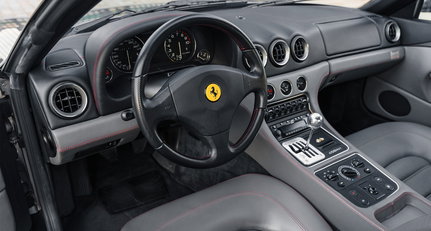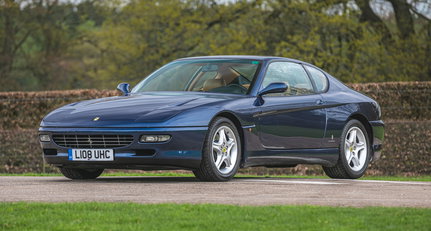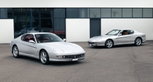


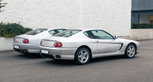


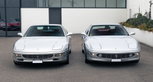
It may not grab attention at first glance, but the 456 GT is unquestionably one of the most significant Ferraris of the last four decades. The elegant gran tourer was penned by Pietro Camardella, who had already designed icons of the prancing horse such as the F40 and 512 TR on behalf of his employer Pininfarina. Unveiled at the Paris Motor Show in October 1992, it was a real breakthrough for the Italians in the segment of long-distance and occasionally family-friendly sports cars.
Its predecessor, the 412, represented the final evolution of Ferrari's classic V12-powered 2+2 lineage and was itself essentially a further development of the 365 GT4 2+2, a design that was already 17 years old at the time. When the 412 was discontinued in 1989, it left a gap in the Maranello manufacturer's lineup that would remain unfilled for nearly three years.

A major step forward
Compared to the 412, which had become increasingly outdated both visually and technically, the new 456 GT represented a fresh start. It was a ground-up development, as the tastefully restrained and noticeably more aerodynamic design makes immediately clear.
Under the lightweight composite bonnet sits a completely new twelve-cylinder engine, with which Ferrari abandoned the timing chain in favour of a timing belt, bringing meaningful gains in smoothness and weight reduction. For the first time on a Ferrari in this class, a six-speed gearbox was fitted, mounted at the rear axle for optimal weight distribution, alongside an adjustable suspension system from Bilstein, which was standard from the factory.
This gave the car a level of ride comfort previously unheard of in a Ferrari, which, combined with the luxurious interior, improved cabin space and the powerful twelve-cylinder, made the 456 GT the perfect travel companion. Whether a shopping trip to Milan or a spirited drive down the Amalfi Coast, the car seemed tailor-made for both. More than a few style-conscious businessmen also used it for their daily commute to the office.
But is the 456 still suited to long-distance travel and occasional everyday use nearly 34 years after its debut? "The 456 is still a wonderful Gran Turismo today, with velvety V12 power, comfortable seats and true grand tourer character on any motorway," the experts at Niki Hasler AG, the renowned Basel-based Ferrari dealer, restoration specialist and Ferrari Classiche partner, told Classic Driver.


Window seal leaks are a common issue
Of course, all of this assumes the car is in sound mechanical condition. Overall, the 456 is considered a solid machine, but Maranello's 90s GT is not immune to certain age-related issues. The original version also suffered from a handful of minor teething problems. "The 456 GT was prone to leaking rubber seals that caused wind noise at high speed. This problem was resolved on the 456M GT," notes the Swiss Ferrari institution.
The additional letter M in the model name stands, in typical Ferrari fashion, for "Modificata", indicating a thorough update. The 456's facelift version was presented in spring 1998 and remained largely faithful to the original, but addressed several weak points and brought a number of technical novelties. In the case of this gran tourer, this meant above all a revised engine management system including an optimised ignition sequence, the addition of traction control and electronic brake force distribution, the latter being a first for Ferrari. The biggest changes from the facelift, however, were felt inside the cabin.
One further minor weakness of the 456 GT concerns the electrically adjustable seats, which represent a significant comfort improvement over the brand's previous 2+2 models but can occasionally give trouble. A even less appealing case of material ageing shared with many cars of this era is the so-called "sticky button" syndrome, where interior buttons become sticky over time. According to Niki Hasler AG, however, this is easy to fix.


A regular timing belt replacement is essential
The 5.5-litre V12, which is good for 442 hp, is generally considered durable and reliable, provided the timing belt is changed at regular intervals. If it snaps or skips, the pistons collide with the valves. With 48 valves and twelve cylinders in total, this amounts to nothing short of a catastrophe. In the worst case, an engine rebuild can run well into five figures, so adhering to the service intervals is absolutely essential.
As a Ferrari owner, a disciplined approach to maintenance should come naturally anyway. The experts from Basel are reassuring on this front: "No need to panic. The intervals are clearly defined: every three years or 30,000 km, whichever comes first. The job itself? Around six hours of workshop time. Not trivial, but for a V12 from Maranello, entirely manageable and easy to plan for."
The adaptive suspension can become troublesome with age
At the rear of the car lies another potential weak point that can prove costly. This is something to examine carefully when inspecting a potential purchase. If you have the opportunity to put the car on a lift, make sure to take a close look at the self-levelling rear suspension. Any traces of oil or signs of leakage around the system are a clear warning sign and can become expensive to address.
An internal membrane separates the hydraulic fluid from the nitrogen gas within the spheres of the hydropneumatic system. Over time, this membrane can become porous or tear. The gas escapes and the sphere fills entirely with oil. Since oil cannot be compressed, the rear axle loses all suspension travel and the elegant gran tourer begins to bounce. Further potential failure points include the dampers themselves, which can develop leaks, as well as their actuator motors, which may fail as the car ages. Within the community, the 456 GTA's automatic gearbox has never been particularly well regarded, but it is better than its reputation suggests. As long as the service history checks out, there is no need for excessive concern.


Only the manual gearbox delivers the true Ferrari experience
When it comes to demand, the automatic version is firmly overshadowed by the classic manual gearbox. This is confirmed by Niki Hasler AG, which sees the reason clearly in the more emotional driving experience: "The driver wants to be actively involved, and the famous 'click-clack' of Ferrari's gated shifter has become a cult sensation today that more and more buyers are specifically seeking out. That metallic, precise engagement of the gear changes is one of a kind." For this reason, the team also makes a clear recommendation to their customers: go for a manual 456.
Even though the automatic GTA is considerably cheaper and can be found from around 80.000 euros without a documented service history, the experts advise against such cars. According to them, prospective buyers should budget at least 130.000 euros for a good 456 GT. "A decisive factor is Ferrari's Classiche certification. It is not only a significant price driver, but above all a strong signal of the seller's seriousness and the car's authentic condition. A certified example offers the buyer a level of security that is priceless, as well as preserving its value into the future," they told Classic Driver.


Prices are set to rise considerably in the years ahead
Although the 456 still ranks among the more affordable Ferraris, a considerable increase in value is expected for the 2+2 coupé, of which only 3,289 examples were built until 2004. "Both the Ferrari 456 GT and the later 456M GT are among the most interesting buying opportunities in the classic Ferrari segment. What many overlook is that you get a full-blooded V12 gran tourer from Maranello for your money, equipped with everything Ferrari's engineering department had to offer at the time. When you put that in relation to contemporary Ferrari models with V8 engines, which today frequently achieve similar or even higher prices, the discrepancy becomes particularly striking."
To ensure the coupé genuinely delivers both a return on investment and driving pleasure in the long term, no compromises should be made when choosing the right example. A Ferrari 456 GT without complete documentation is, in the view of Niki Hasler AG, a significant risk, whereas a well-documented example represents a genuine opportunity. A service booklet and a complete service history, with entries exclusively from authorised Ferrari dealers, should always be included in the package.
Photos: Niki Hasler AG