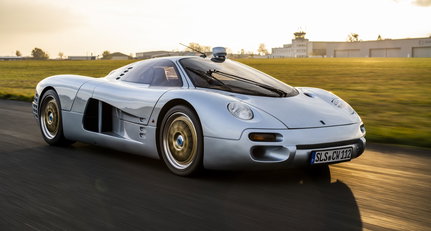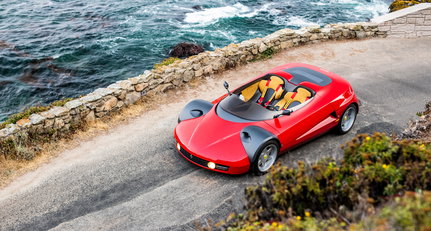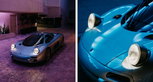


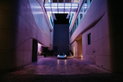


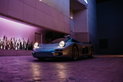
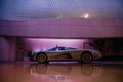

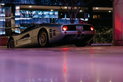


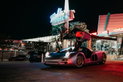




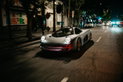
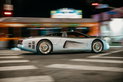


Los Angeles after dark always feels like a movie set — stripped of the day's noise, reduced to neon lights and blurry motion, you can easily shoot a film noir on these endless, palm-lined boulevards. Or a cyberpunk sci-fi opera. You just need a street-legal spaceship, a camera — and you're rolling. Like a liquid metal teardrop, an early 1990s CGI sculpture straight out of the special effects studio Industrial Light & Magic, the Isdera glides out from the palms of the Beverly Hills Hotel and slips onto Sunset Boulevard, alone in its own frame.


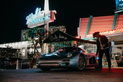
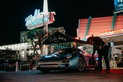
Rodeo Drive flickers past in reflections of glass and chrome before the tempo lifts along the neon stretch of the Strip, colours bleeding across its silver bodywork. It cuts north through Hollywood Boulevard, the glow of the Walk of Fame passing beneath it, then west again to Melrose, where murals blur into streaks of colour. There’s little traffic, no interruption — just the car and the city moving in sync, a low, mechanical rhythm echoing between buildings. By the time it loops back down Canon Drive and pulls into Mel's Drive-In (of American Graffiti fame), the night feels momentarily still, as if the whole sequence has been running on a loop.


If it looks like something out of a PlayStation game, that’s because it is — or was. The Isdera Commendatore 112i became a cult icon through Need for Speed II, where its exaggerated proportions and improbable performance made it feel more like fantasy than a factory-built machine. But unlike most digital legends, this one exists — a one-off vision from Eberhard Schulz and his boutique marque Isdera, created at a time when the boundaries between road car, race car, and imagination were still fluid, like the mimetic polyalloy antihero in Terminator 2.


With its 6-litre Mercedes V12, Ruf-tuned gearbox, Porsche suspension and headlamps, periscope mirror, Shinkansen windshield wiper,and model name chosen in tribute to Enzo Ferrari, the Isdera Commendatore 112i was the all-star 1990s hypercar only a few people ever heard of. It also captured the optimism, excess — and freedom for experimentation — of the era like few others. Decades later, in the heart of Hollywood, it feels less like a relic of an analogue age and more like a glitch in time: a machine that was never meant to be real, still moving through the world as if it isn’t entirely convinced that it is.

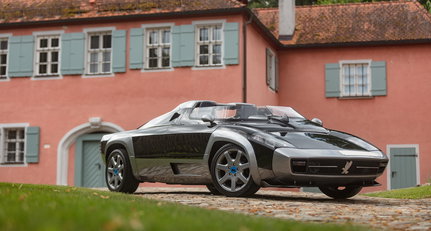
Owned by Philip Sarofim, the Isdera Commendatore 112i shares its garage with two otherworldly spaceships of their time — Marcello Gandini's radical, wedge-shaped Lancia Stratos HF Zero from 1970 and the brutalist 1980 Aston Martin Bulldog designed by William Towns. So the next time you see a UFO after dark on the streets of LA, it might not be an alien after all, but just a a fellow Angeleno in need of a midnight milkshake at Mel's Drive-In.
Video & Photos: Alpineracer for Classic Driver