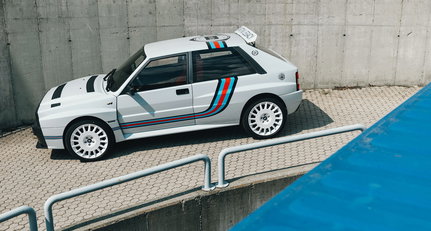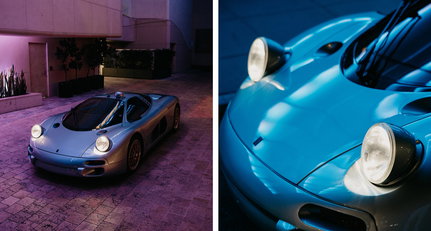




















The Tuono was a previously unseen concept car developed by Italian boutique manufacturer Automobili Amos and revealed by its founder Eugenio Amos as a passion project conceived during the 2020 lockdown. Designed in collaboration with the Milan-based studio BorromeodeSilva, the car was envisioned as a radically different follow-up to the company’s celebrated Lancia Delta Futurista restomod. Instead of reinterpreting a classic rally icon, the Tuono was planned as a completely new car built from a blank sheet and powered by an electric drivetrain.


Early teasers suggested a compact, aggressive machine with wide fenders, roof-mounted rally lights, and a possible mid-mounted electric powertrain, hinting at a rugged, rally-inspired car capable of tackling dirt and off-road terrain. Conceived as an enthusiast-focused answer to an automotive world rapidly shifting toward electrification, the project aimed to translate Automobili Amos’s analogue rally spirit into a modern electric format — described by Amos as a 'love letter to the future'. However, the ambitious concept never progressed to production and remains an unrealized vision of an electrified, rally-ready all-terrain machine.


However, what is most striking about the concept car is the sound — a statement that can be made about very few electric cars. In fact, there is a reason that Automobili Amos’ all-terrain EV concept was called Tuono, which is Italian for thunder 'Sound was the key to the whole project,' says Carlo Borromeo of BorromeodeSilva. 'Electric performance is undeniable. What people miss is emotion. Combustion engines move us because of the explosions, because of fire. They feel alive.'


Eugenio Amos and Carlo Borromeo asked themselves: how could electricity feel just as alive? They set three rules: 'First, the sound had to be real — not a recording through speakers, but something physically generated by the car itself. Second, it had to be infinitely variable. Like an engine on a cold morning, no two moments should ever sound exactly the same. Third, it had to connect to something instinctively powerful. If combustion has fire, electricity has thunder.'
Together with sound engineer Simone Merli, the team at Automobili Amos and BorromeodeSilva developed and patented a device that uses the actual electrical flow of the powertrain to create controlled 'micro-thunder' events inside a chamber. Their intensity and pitch change in real time, reacting to fourteen parameters including acceleration, braking, lateral G-forces, speed, and temperature. The result is then amplified and projected outward. 'We built a prototype,' says Carlo. 'It sounded like a thunderstorm. Hear it for yourself.'
Photos: Piotr Degler / Livery & Rendering: Davide Virdis