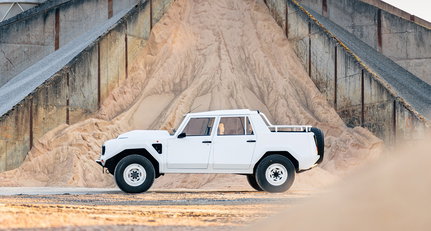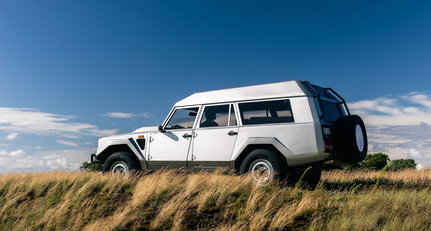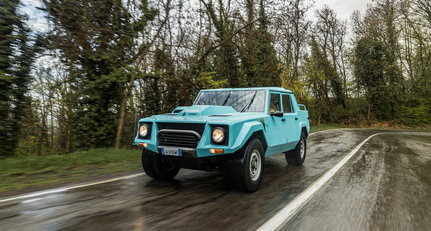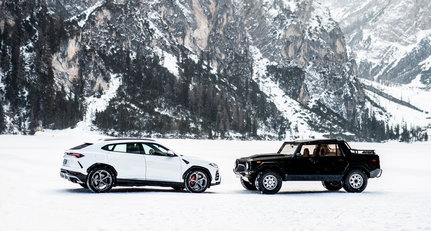


The Lamborghini LM002 — or “Rambo Lambo”, as it was dubbed in period as a reference to the equally bold and Italian Sylvester Stallone — is a roaring icon of 1980s excess, where more was always more and subtlety was for the timid. Imagine a monstrous V12 engine strapped into a military-style SUV, all sharp angles, brutal lines, and that unmistakable Italian flair for over-the-top indulgence. Born from Lamborghini’s brief flirtation with military vehicles in the late 1970s and a pitch for the US Army to replace the Willys Jeep in the form of a dune buggy named Cheetah, the LM002 went from battlefield prototype to status symbol, attracting oil barons, warlords, arms dealers and eccentric billionaires alike. Its “go big or go home” ethos proved that sometimes the only way to stand out is to drive something utterly unmissable.


French racing driver Henri Pescarolo even wanted to win the mythical Paris-Dakar Rally with the truck-weight Lamborghini LM002. But the car's much-ballyhooed rallying career soon became a comedy of errors: early attempts to turn the “Rambo Lambo”, with its massive V12 and 600-litre fuel tank, into a Dakar contender never got out of the gate or even to the finish line, with entries in the Rallye des Pharaons and a Greek rally ending in non-starts and retirements due to funding and mechanical woes. Even a later Dakar bid in the mid-1990s succumbed to relentless suspension failures and lack of spares, forcing the massive V12 SUV to bow out long before claiming desert glory.
But what if Lamborghini had managed in period to design and build a smaller, more lightweight and competitive homologation prototype? This hypothetical question bothered the automotive designer behind Meanmachines, a creative think tank that has reimagined and refined many legendary cars, from a wide-body street version of the Nissan Skyline JGTC R34 to a Renault Twingo F1 racer. "I have always liked the LM002," says the anonymous creator, "but from my point of view, it lacks stance and proportional refinement. That is why I created this car."


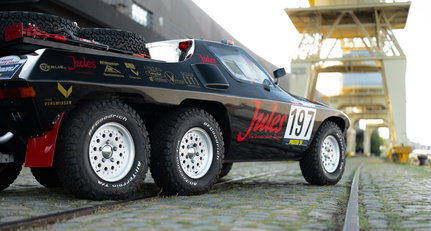
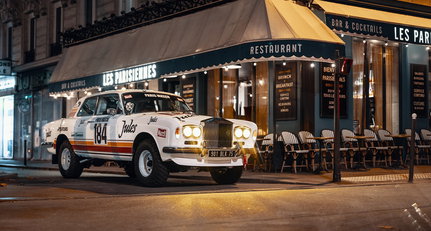
This reimagined Lamborghini LM002 "Martello" restomod presents a radical shift from the original "Rambo Lambo" by trading raw, utilitarian bulk for a sleek, well-proportioned, minimalist aesthetic. While the 1980s original was defined by its massive footprint, heavy riveted aluminum panels, and a complex front-end cluttered with exposed vents and a massive hood bulge to clear the V12’s air cleaners, this concept adopts a "less is more" philosophy. The design replaces the original's busy front fascia with a clean, recessed grille housing modern halo LED rings and a simplified, vertical-slat central intake. The bodywork is significantly more compact and streamlined, featuring a sharp, sloping rear 'estate' silhouette that replaces the classic open-back pickup bed. Furthermore, while the original sat on bulbous, bespoke Pirelli Scorpions, this restomod utilizes a more aggressive, high-clearance stance with white multi-spoke wheels and high-profile off-road tyres that emphasize a lighter, more agile rally-raid character over the armored-truck presence of its predecessor.


"Since my background is exterior design, I teamed up with Dasha, as one of her amazing skills is interior design. Her work is creative, fresh and different and stands out in the vast crowd of creative people, so I asked her if she would create an interior for the Lambo, and she agreed." While the original LM002 featured a cramped, wood-trimmed cabin dominated by a massive center tunnel and cluttered analog dials, the restomod design opts for a hyper-minimalist, airy cockpit with a sculptural yoke and jewelry-like knurled controls. It trades 1980s rugged excess for a serene, futuristic aesthetic that prioritizes clean architectural lines and floating surfaces.


Dasha says: "I was thinking: what happens when a machine designed with military logic is reinterpreted through the lens of product design? The interior is structured around a rigid T-shaped architecture. Steering controls are not hidden - they are exposed, prominent, and spatially anchored. The steering wheel has an unorthodox structure; the goal was to explore different UI interactions, from rotary dials to toggle switches and push-buttons, echoing the feel of aircraft cockpits before takeoff. The seats, with their bucket-like geometry, stay on the border between equipment and chair-like furniture."


Would 1980s Lamborghini, with its constant changes in ownership and struggle against entropy, have been able to put such a sophisticated car on its wheels? Would it have had a chance against the Mercedes-Benz 280 GE or the Porsche 959 in the Paris-Dakar Rally? Probably not. Still, it's a great exercise in creative thinking and alternative world-building. And who knows, maybe there is an affluent rally driver out there who falls in love with the idea and makes the dream of a "Baby Rambo Lambo" a reality.