



We are in the late 1960s. At Aston Martin in Newport Pagnell, the era of the glorious six-cylinder models was drawing to a close. The DBS, last representative of a bloodline that stretched back down to the DB4 of 1958, had reached the power pinnacle with its four-liter inline-six. The future Aston Martin was evolving into a heavier, luxurious car that would need more grunt, since the six cylinder could not be comfortably stretched above four liters, Now the question arose: Go all out with a V12? Or upgrade 'only' to a V8? The choice fell on the V8, developed again by Tadek Marek, the legendary designer of the six-cylinder family of engines. His new powerplant was again cast entirely in aluminum, and in its final iteration pumps out between 280 and 300 bhp from a displacement of 5.3 liters. The first Aston to profit from the new powerplant was the DBS V8. Launched in 1969, it prominently featured as the company car of Lord Brett Sinclair, alias Roger Moore, in the TV-cult series "The Persuaders."
Then came February 12, 1972 – the day David Brown, owner of Aston Martin since 1947, sold Aston Martin Lagonda to the investment banking concern Company Developments. The new owners injected much-needed funds into the ailing company, and as early as April of the same year kicked off with a two-car lineup: a six-cylinder model with the somewhat confusing name "Vantage" and a new eight-cylinder, rebadged Aston Martin V8 – a designation that would remain until 1990. Already before the departure of David Brown, Aston’s chief designer William Towns had begun work on a major facelift for the AM V8, with the particular aim on a more efficient aerodynamic package.

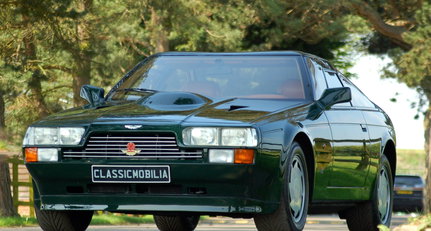
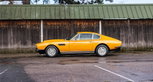
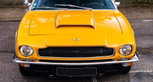
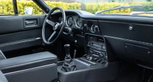
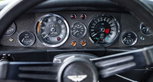
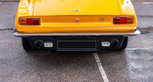
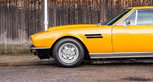
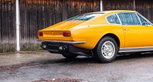
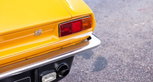
After extensive testing with pre-prototypes like this very first AM V8 shown here (#10500), Aston took the decision to replace the double-headlight front end of the DBS V8 with two single quartz/halogen-headlights and a grille which as a unit, was more in line with the identity of the successful DBs. The interior also received improvements, including a new leather steering wheel and center console. A new fuel tank increased the trunk capacity by 48 liters, and the spare wheel no longer stood upright but lay flat in the trunk.
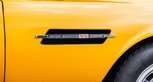
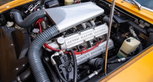
This prototype will now be auctioned at Aguttes' spring sale on March 16th. Its larger air scoop and bonnet bulge indicate an engine fed by four Weber 42 DCNF carburetors, hidden in the vee by the large air cleaner. This specification became standard on all AM V8s from August 1973 onwards, after the Bosch mechanical fuel injection initially used was deemed too heavy, too complex and too difficult to meet stringent US emission rules.


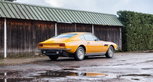
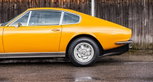
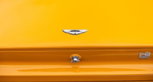
Painted in striking Bahama Yellow – the same color as "The Persuaders" DBS – #10550 was registered in June 1972 and kept by the works until April 1975. After being sold to a Mr. Walsh, it passed into the Foster family, who kept it until the 1990s. In 2008, this British steam hammer arrived in Portugal, before being fully restored in 2017. Shortly afterwards, it was purchased by the current owner and registered in France.
Today, this very first Aston Martin to proudly bear the new V8 front end presents itself in near-mint condition. Now left-hand driven, it is ready for long intercontinental journeys or relaxed cruising in fifth gear of its manual ZF transmission.