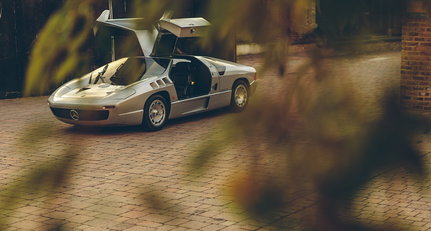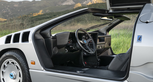
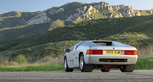
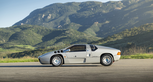
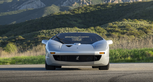
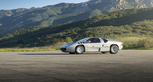
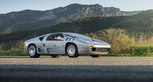
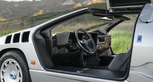
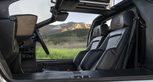
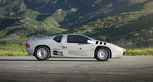
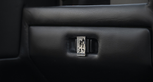
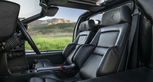


A retrofuturistic eighties wedge with upward-opening doors, often delivered in silver and powered by a mass-produced engine from a much larger manufacturer – no, we’re not talking about the DeLorean DMC-12, but a real sports car: Isdera’s Imperator 108i, which is both far more dynamic and much more exquisite. Eberhard Schulz, the founder of the small manufacturer, placed refined and powerful V8s from Mercedes-Benz,and later also from AMG, behind the seats of his angular 300 SL homage, a far better choice than DeLorean’s rough-idling and asthmatic PRV six-cylinder. Not just the engine, but also the Imperator itself, is the far more exclusive car. Only 30 examples were built between 1984 and 2001.
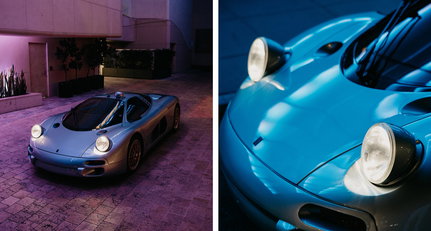
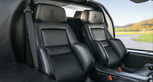
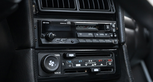
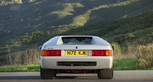
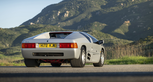
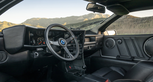
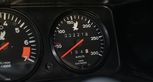
The few cars built sometimes vary quite strongly from each other. RM Sotheby’s will auction off this stunning example at their annual Miami Sale on February 27, 2026. It was completed in 1991, making it one of 13 Series 2 examples and one of only five with the steering wheel on the left. Series 2 Imperators are identifiable by their pop-up headlights and the twin tailpipes integrated into the right flank of the sports car. The offered vehicle, delivered new to Japan and currently showing 2,218 kilometers on the odometer, is estimated to sell for between 650,000 and 850,000 dollars.

The taillights borrowed from the W116 S-Class and the 5.0 badge in the typical Mercedes font already reveal that Isdera trusted in Swabian engineering and big engines from Stuttgart. Not surprising, considering that Eberhard Schulz started his career in 1971 as an engineer at Porsche. Even though he never graduated after studying mechanical engineering, he got this prestigious job because he had impressed the sports car manufacturer’s management with his home-built supercar, the Erator GTE, which reached a top speed of 315 km/h. Even his first creation, which was faster than the Lamborghini Miura or Ford GT40, was already powered by a potent Mercedes V8 back in 1969. Schulz is said to have also presented the vehicle to the world’s oldest car manufacturer, but Mercedes-Benz did not offer him a job.


This was a missed opportunity from today's perspective. After founding his own company Isdera in the early eighties, his most famous creation, the Imperator 108i, was one of the fastest sports coupes of its era, with state-of-the-art design and engineering. The combination of double wishbones at the front and upper and lower transverse links at the rear was not the norm in the sports car world of the eighties, especially not among small manufacturers like Isdera.
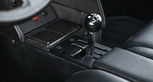
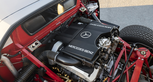
This Series 2 example is powered by Mercedes’ fuel-injected M119 V8 with 32 valves and an aluminum block, which was used in the R129 SL from 1989 onwards and later also found its way into the W140 S-Class and W210 E-Class. 300 hp aren’t that much even by early nineties supercar standards, but thanks to its tubular space frame, wrapped in a spectacular fiberglass body, the Imperator was comparatively light and therefore fast for its time. Paired with a ZF-sourced five-speed manual, this version covers the zero-to-hundred sprint in 5.1 seconds. According to the manufacturer, the rear mid-engined two-seater tops out above 280 km/h.

With these performance figures, the Imperator ranked among the high performers of its time. Combined with the eye-catching exterior design largely carried over from the spectacular 1978 Mercedes CW 311 concept car realized by Schulz in collaboration with Rainer Buchmann (B+B), it gained quite a bit of fame throughout the eighties and early nineties. It was the poster car for those who considered a Lamborghini Countach or Ferrari Testarossa too mainstream. Even more than four decades after its debut, its wow factor has hardly faded.
 city-540b2b09, 27 Feb