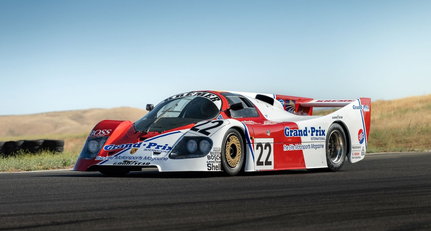
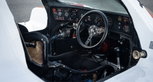
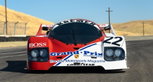
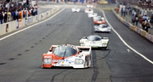
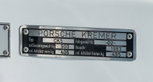
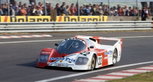

For the first season of the World Sportscar Championship, run in 1982 under the new Group C regulations, Porsche initially kept its first prototype with a monocoque chassis and ground-effect underbody, the 956, exclusively for itself. Deliveries of the first customer cars were not planned until the following 1983 season. Not wanting to sit idly by for a year, the Cologne-based Kremer team created the CK5 as a response to Porsche’s factory-only 956 program.
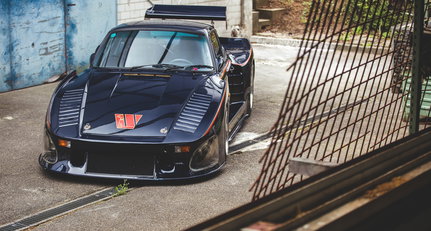
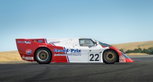
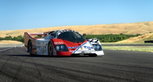
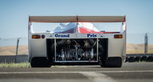
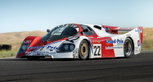
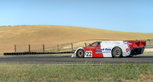
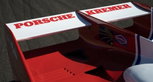
As a real eye-catcher, Ekkehard Zimmermann from DP Motorsport (Design Plastik) designed a distinctive bodywork, featuring a short front overhang and a rear fin that provided stability at high speeds—a feature that wouldn't become standard on sports prototypes for another 30 years. It was combined with a two-piece rear wing, which was more robust than a one-piece version. Only the installation of a diffuser wasn't possible on the homemade Group C, which was dubbed CK5 in reference to the series of “K” creations harking back to 1976.


After Erwin Kremer—himself a driver who achieved overall and class victories in numerous GT races in the 1960s driving a Porsche 911—and his brother Manfred had founded their workshop 1962 in Cologne, their team had evolved into a highly innovative and leading Porsche customer squad. In 1976, their 935 "K1" gave the Porsche factory cars a run for their money, followed in 1977 by the "K2," which with Bob Wollek at the wheel was always a contender for a podium finish. Their major breakthrough came with the 935 K3: victory at Le Mans and a dominant run by Klaus Ludwig in the “Deutsche Rennsport-Meisterschaft.” The Kremers also built their own version of the open-top 936, the 917/81, a unique model inspired by the legendary 917, and the K4 as the most radical evolution of the K3. But now it was time for Group C to take center stage.
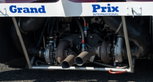
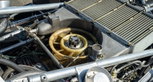
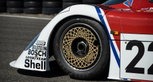
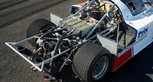
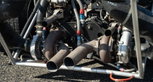
While rival customer team Joest simply took a 936 and converted it into a 936 C with a closed body, Kremer took a different approach. As a base, they chose an aluminum spaceframe – argon-welded from elements of a 908/3 and 936 frame. This was clad in a body made of Kevlar and carbon fiber. Many components they took from their own 917 parts bin: like the four-speed Type 920 gearbox, designed to handle the 1,000 hp of the 917/10 Turbo. 16-inch BBS wheels allowed for the installation of the large 917 brake system, and also suspension components and even the steering column were of 917 origin. Unlike the factory team (with its 2.65-liter engine featuring water-cooled cylinder heads), the team in Cologne opted for a venerable, proven solution: a 2.8-liter, air-cooled, twin-turbocharged flat-six.


Kremer built two CK5s. Chassis 01 debuted at Le Mans in 1982 with the all-American crew of Ted Field, Danny Ongais, and Bill Whittington. At that time, on the hood, it still featured four air intake “snorkels” for direct airflow to the intercooler. The car was clocked at 207 mph on the Mulsanne Straight and started from eighth on the grid. Unfortunately, the Americans' performance was already over after less than two hours with a burned piston. At the end of 1982, Kremer sold the car to British privateer Richard Cleare.
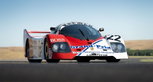
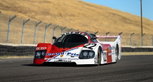
The CK5-02, developed for 1983, will be auctioned at the Broad Arrow Porsche Air-Water Auction on April 25th. The four snorkels on the rear hood were replaced by two larger airboxes for even more efficient air intake. The engine displacement was increased by 200 cc to a full three liters. Depending on the boost setting, the flat-6 had an output of 630 to 720 horsepower, even more than the works 956 had at that time.


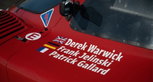
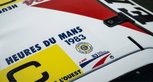
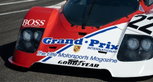
Racing in the colors of Grand Prix International Magazine, the brand-new CK5 debuted at Le Mans. Two of its three drivers were Le Mans rookies: Derek Warwick, then driving for Toleman in Formula 1, and top German sports car driver Frank Jelinski. For Frenchman Patrick Gaillard, however, it was his third outing at the Circuit de la Sarthe. Warwick qualified the CK-02 as the best non-956 and non-Lancia in 14th position. In the early stages, he held this position, but shortly after 10 p.m., another engine failure forced an early retirement. Dutchman Kees Kroesemeijer then acquired the CK5 in September and entered it in the World Championship races at Spa, Brands Hatch, and Kyalami. Further forays followed in 1984 at Monza, the Nürburgring, Brands Hatch, Spa, and Sandown Park.

Halfway through the 1985 season, Kroesemeijer traded the CK5 in for a Porsche 956. Next, the car reappeared in a striking dark blue for a promotional video for Kremer’s new sponsor, additive manufacturer SAT. Later, the blue beauty caught the eye of Austrian-Canadian oil magnate Walter Wolf, whose F1 team used to campaign its cars in this color. He adorned the car with his signature red and gold accents and used it for promoting his Walter Wolf products.
After its time with Wolf, CK5-02 entered the Freisinger Motorsport collection before making its way to its current US owner in 2018. In 2022, the decision was taken to restore the car to its 1983 Le Mans livery. Since then, it has rarely appeared in public, most recently in 2023 at Rennsport Reunion 7. The car will be a highlight at Broad Arrow's Porsche Air / Water auction taking place in Costa Mesa on April 25th. It is estimated to fetch between $600,000 and $750,000.


As a testament to the early years of the glorious Group C era and the ingenuity of the Kremer brothers, the CK5 impresses with its high degree of originality. However, due to the age of its components, a complete overhaul and requisite safety checks are required prior to any further seat time. The next owner must, therefore, decide to either preserve it in its current condition or to get it running again for historic events like the Le Mans Classic. For all the fans of this significant turning point in international long-distance racing, we would very much prefer the latter.
Photos: Broad Arrow