



‘Long runs well’ – among aerodynamicists, this phrase is almost law. It describes the fluid dynamics phenomenon whereby elongated bodies divide the air more efficiently and minimise turbulence. The paragon and ideal shape is that of a water drop – round at the front and long at the rear. Although this basic principle of fluid dynamics was already well known to the designers of the Benz ‘Tropfenwagen’ in 1923, from the 1960s onwards, no one applied it as consistently and experimentally in motorsport as Porsche. The 908's predecessors, the Carrera 6 and 907, were already fitted with ‘long tails’ for use on ultra-fast tracks such as Spa, Le Mans and Monza, in order to approach the 300 km/h barrier at La Sarthe, for example. Later, with the 917 LH, they came close to breaking the imaginary 400 km/h barrier... The fact that the drivers had to come to terms with slightly less downforce in corners was a small price to pay. The stopwatch had the final say anyway, and it never lied.

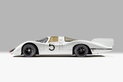
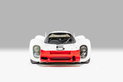
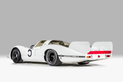
The 908 was the most powerful Porsche sports prototype to date, boasting a 335 hp three-liter eight-cylinder engine, which reached up to 370 hp in its final evolution. Initially, like chassis 908-004 shown here, it featured a steel frame, while from chassis 908-012 onwards a lighter aluminium space frame was used. 908-004 and its sister car, 908-003, made their debut at the 1000 km of Monza in April 1968, after the 907 had still represented Porsche’s colours in the three preceding rounds of the championship. For the race on the combined Monza Grand Prix circuit and high-speed oval, both sported a long tail flanked by two vertical fins. While the brand-new 908s easily reached the predicted 300 km/h mark, their new engines still suffered from teething problems. The result: After starting from P4 and engaging in heated battles with the Gulf-Ford GT40s in the early stages, problems with the throttle linkage and fuel injection system forced Ludovico Scarfiotti and Gerhard Mitter to make lengthy pit stops after only a quarter of the race distance. The consequence: only eleventh place overall and P3 in class. In its second outing, the 1000 km of Spa, car 908-004 was only used in practice. Because it poured rain on race day – making the 14-kilometre (old) circuit in the Ardennes even more dangerous than usual – Vic Elford opted to start in a short-tail 908, which was more forgiving on a wet track.


After Spa, 908-004 was retired from active service rather painlessly – not unusual for Porsche at the time, as new updates were introduced at extremely short intervals. Already for Le Mans the factory would roll out new long-tail 908s, featuring movable flaps at the outer ends of a transverse wing stretched between two tail fins. In that configuration the cars achieved a certified top speed of 335 km/h on the Mulsanne Straight.


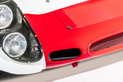
From then onwards the fate of 908-004 was closely linked to Gérard Larrousse. Winner (in a Porsche 911 R) of the 1969 Tour de France, second in Le Mans that same year (with Hans Herrmann, in a 908-LH), and later head of motorsport at Renault and owner of a Formula 1 team. As compensation for outstanding payments, Hans Dieter Dechent, founder of the Martini & Rossi International Racing Team, gave the car to the Frenchman in May 1971, albeit in a sorry state. Larrousse initially had no concrete plans for it but ultimately decided to have the car restored by Freisinger Motorsport in Germany. By 2014, the Porsche was once again roadworthy, equipped with the 908-02010 engine and the 916/128 five-speed gearbox, as well as rare chassis components made of titanium and magnesium. After an initial outing at the Le Castellet 10,000 Tours, the long-tail Porsche thrilled fans at the 2016 Le Mans Classic, driven by former Porsche factory driver and 1971 Le Mans winner Gijs van Lennep. In 2023 the car was acquired by its current owner, who commissioned a reconstruction to the exact 1968 Monza race specs – including starting number 5, red accents on the front and rear and the authentic tail section. After a full mechanical service the engine was dyno-tested by Crubilé Sport to a healthy 335 hp at the wheel.

In October 2023, this beautifully restored 908-LH made its US debut at Rennsport 7, where it was reunited once again with Gérard Larrousse. Now, this early 908 with a steel tube frame, one of supposedly only five surviving examples, is ready to defy the wind once again at the next editions of Le Mans Classic or Rennsport Reunion. This weekend, you can already catch a glimpse of the long-tailed wonder at the Amelia Concours in Florida, where it is presented in its full glory by Art & Revs from Luxembourg. And if you still have a free parking spot in your private motorsports hall of fame: The Porsche 908 Langheck is also listed in the Classic Driver Market.
Classic Driver will broadcast live from the Amelia Concours – follow us on Instagram and YouTube to see the greatest cars on the lawn.

 N/A
N/A