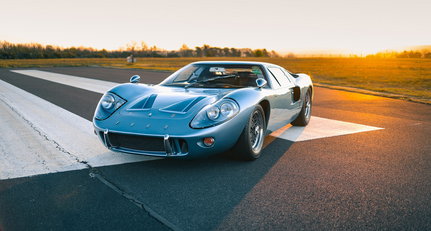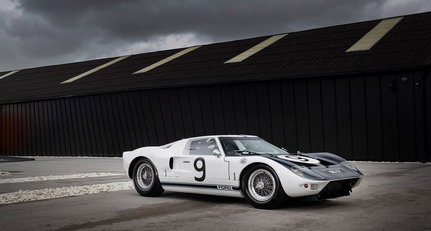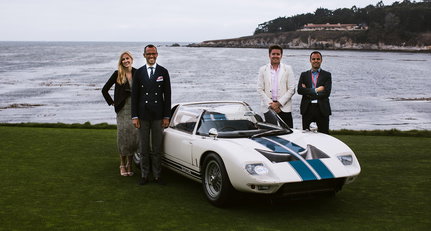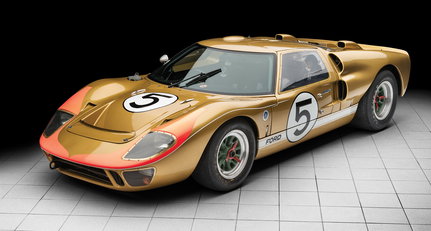


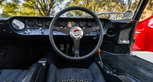
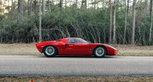
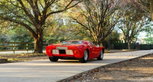
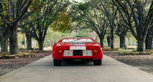

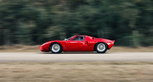




Ford has produced some truly unforgettable cars over their century-stretching life span. The Model T, RS200, Escort Cosworth, Mustang, F150, pick just about any genre of vehicle and there’s a good chance a Ford will appear amongst the front runners. This is very much the same when it comes to motorsport, too, with the Ford GT40 becoming the marque’s most adored speed machine, collecting lap records and trophies like they were cigarette cards quite literally from the moment the car was born, creating a myth-like fairytale that remains one of the best in racing history. But mythology is the easy bit. The hard part is understanding how something so purpose-built, so uncompromising, ever ended up with road-car touches like door pockets and carpets. That’s exactly what makes this example heading to RM Sotheby’s upcoming Miami sale on 27 February 2026 such a fascinating machine.

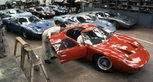
Let’s start with the detail that separates this car from the already ultra-rare crowd. Total GT40 production across all variants is often quoted around 133 cars, within that universe, the Mk I is the original silhouette most people picture. It’s compact, brutal, and famously just 40 inches tall, within Mk I production, this car is part of an even narrower set, one of only 31 Mk I examples specified as road cars. Why did Ford bother? Like so many amazing road cars, homologation plays a part, but also as a way of gaining popularity and awareness of the brand, allowing the race cars to gain a much larger fanbase after seeing the road-going version tear up the tarmac, legally. The roadgoing Mk I cars were part of Ford’s effort to satisfy requirements for the FIA’s Group 4, avoiding Prototype classification. That meant the racing monster had to play dress-up as something you might theoretically use to pop out for milk, if your local grocery store was located at the end of the Mulsanne Straight.


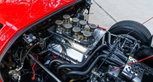
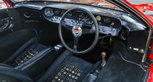
Despite being a road-specification car, don’t expect it to be lethargic or luxurious. These cars did however gain a handful of creature comforts, including fender-mounted side mirrors and a windshield-mounted rearview mirror, as well as reverse lights, a heated windscreen, leather-trimmed seats, door storage pockets, the all-important ashtray and cigar lighter, and a fully carpeted interior. Powered by Ford’s legendary 289 High Performance V8, featuring original sand-cast Weber carburettors, and it’s backed by a five-speed ZF transaxle. That combination is central to the Mk I experience: a compact, highly-strung V8 breathing through Webers is the true essence of why these cars feel so alive, even at idle.

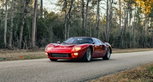
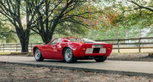
Today the car is presented in its original factory shade of Carmen Red over a black interior, it was repainted and mechanically refreshed in the 2000s by Harley Cluxton III’s Grand Touring Cars in Scottsdale, Arizona, with an emphasis on returning the car to its authentic period appearance. The interior was also restored, with effort made to keep as much of the original upholstery as possible. Collectors will appreciate the small tells that suggest this car hasn’t been endlessly “rebuilt into itself.” This is backed up by riveted “1058” tags which can still be found throughout the car on various body panels, a wonderful breadcrumb of originality that give this stunning example real heritage. Better still, it retains the small luggage boxes beneath the rear clamshell, presented technically to let the GT40 meet storage requirements necessary for racing qualification.


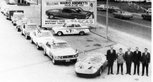
The backstory of this example is as impressive as the way it is presented right now, originally shipped to Dearborn, Michigan, for Ford publicity use in December 1966, as part of a group of seven GT40s sent from Ford Advanced Vehicles’ Slough factory. Finished in Carmen Red, it was officially assigned to Ford’s Promotion and Disposal Program in February 1967 and wasn’t a GT40 that immediately disappeared into a private collection. It was a GT40 that did the rounds, a halo car deployed to make people stop, stare, and then wander over to the nearest showroom window to ask about Mustangs. After various new owners within the year 1967, in late 1968 the Mk I was sold to David Carroll of Massachusetts, who repainted it in yellow in an attempt to reportedly escape the notice of local law enforcement, which is an objectively hilarious ambition when your car is a GT40. During this time, the car was used to record audio for TV commercials, bringing that glorious V8 roar to life and no doubt scaring the sound guys along the way.
1969 would see the car go to racing driver John “Skip” Barber, the founder of the Skip Barber Race Driving School, then the GT40 finally found longer-term ownership when it was acquired by Harvey Siegel of New York City, who kept it for decades. Fast forward a few decades to 2014, the car is now in the hands of the current consignor, where the GT40 has continued to receive careful maintenance and service as needed, and in 2021 the engine was refreshed, then properly tuned. The car has been shown selectively, winning Best in Class at Keels and Wheels Concours d’Elegance in Seabrook, Texas, in 2018, and it has been exercised on solo test drives at Circuit of the Americas, which is about as tasteful a place as any to remind a GT40 what it was built to do.


If you’ve ever wanted a GT40 that doesn’t just represent the legend but participated in the culture that built it, including publicity photos, showroom spectacle, registry documentation, and much, much more, this is a serious opportunity. With an estimate of 6.5 to 8 Million Dollars thrown around, all eyes will be on this road-legal legend at RM Sotheby’s sale!
 city-540b2b09, 27 Feb