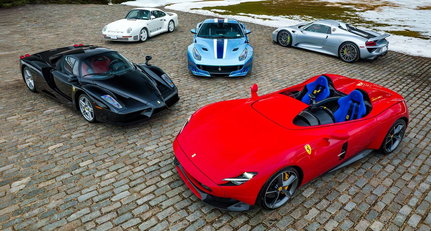
The auction house Broad Arrow, driven by Hagerty, is offering an outstanding selection of collector cars at their annual Amelia Concours Auction, which 2026 edition takes place on March 6th and 7th. Three icons are especially interesting, because they represent the pinnacle of their era's sports car technology.
Lamborghini invented the supercar theme with the mid-engined, V12-powered, and Gandini-drawn Miura – the new shape of speed of the late sixties and early seventies. Two decades later, Ferrari shocked the car world with the uncompromising F40, the last road car overseen by the Maestro himself. An unforgettable way to celebrate the Maranello brand's 40th anniversary. Shortly after the turn of the millennium, the supercar crown went to Germany – to Zuffenhausen, to be exact. Porsche's passion project, the Carrera GT, defeated the Italian competition with its high-revving, naturally aspirated V10, timeless teutonic design and a unique level of precision. All three cars are a must-have for every credible supercar garage.


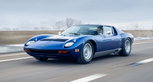
1972 Lamborghini Miura P400 SV
Nothing was the same after Lamborghini had premiered the Miura at the Geneva Motor Show in March 1966. The bull from Sant’Agata was a technological tour de force from a manufacturer with literally zero racing pedigree, which was mainly provoked by the founder’s archenemy, Enzo Ferrari, to produce a superior sports car. And the new Miura was more modern than anything from Maranello in many ways. First of all, it was only the second mid-engined production car, beaten only by the Matra Djet, with a powerful transversely mounted V12 behind the seats and a rigid chassis whose development was overseen by Dallara, a revolutionary recipe that made it the blueprint for the modern supercar. And then there was the spectacular and low-slung Bertone body with the pop-up headlights and aerodynamic rear window louvers.
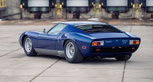
Almost exactly sixty years after the Miura's launch, Broad Arrow auctions off a largely original example, which doesn’t have the characteristic eyelashes, because it’s a late SV version, built during the winter season 1971 / 1972. The SV was more mature and also more powerful than the earlier versions of the Italian pioneer. Its 3.9-liter twelve-cylinder fed by four Weber carburetors put out 385 hp, 15 more than the P400 S and even 35 more than the engine of the first version. This example with the chassis number 4976 is one of only 13 US-destined examples that were equipped with the sought after split-sump oil system and Borletti air conditioning.
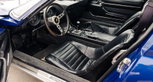
It originally left the factory in the silver hue 'Argento Indianapolis Metallizzato' combined with a black leather interior and grey carpets, but was resprayed in this dark blue by the end of that decade. The current color comes close to the factory shade 'Blu Notte' and perfectly suits the car. One year after the car was first delivered to the US concessionaire Modena Racing Company, it was sold to the Texan collector Dr. Hector A. Escamilla, who kept it in his possession for more than half a century. He enjoyed driving his understatedly specced bull from time to time, as it had 18.212 miles on its odometer when it was cataloged for the auction. The engine was swapped with the engine of another Miura P400 SV shortly after the car had arrived in the US, but the original powertrain was recently rebuilt and reinstalled, so the car now has matching numbers. This late Miura is preserved in a excellent original condition and is expected to sell for 3.5 to 4.0 million dollars, which is a rather average estimate for this version nowadays, as prices for late Miuras have increased quite heavily over the last three years.


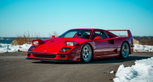
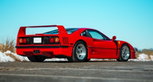
1990 Ferrari F40
The supercar was elevated to a new level when Ferrari unveiled the F40 on the 21st of July, 1987. More than just an anniversary celebration, the vehicle redefined the very essence of the genre by translating the mechanical purity of a racing machine into a road-legal format. Under the technical direction of Nicola Materazzi, the engineering team developed a 2.9-liter twin-turbocharged V8 and an innovative carbon-fiber and Kevlar chassis to create a new benchmark when it came to performance. This uncompromising approach realized Enzo Ferrari’s final vision of a 'true Ferrari', and its wind-tunnel-honed silhouette laid the groundwork for dozens of exotic flagships that were about to follow.
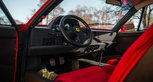
The car with chassis number 87219, a US-specification model that left the factory in October 1990, provides an especially unfiltered experience. As one of only 213 examples destined for the United States, this particular car is highly regarded for being a non-adjustable version, meaning it lacks the later electronic suspension systems in favor of a more direct, fixed setup. Its documented history began on the 29th of December, 1990, when it was delivered to its first owner, Thomas Murphy, through Continental Motors in Illinois for a retail price of almost 400.000 dollars. The car later transitioned to the long-term stewardship of neurosurgeon Dr. Sheldon Lazar, who maintained the Ferrari for eleven years, entrusting it to Lake Forest Sports Cars for consistent specialized care while keeping the mileage low.
Over the following two decades, the F40 went through the hands of collectors in Florida, California, and Texas. In May 2008, it received the Ferrari Classiche Red Book certification, verifying that the chassis, engine, and transmission remain the original, factory-installed units. The car’s mechanical integrity has been further bolstered by an uncompromising service history, most recently evidenced by a comprehensive 21.000-dollar major service executed by Miller Motorcars in December 2025. Now showing just 8.065 miles, the car remains in concours condition, a status confirmed by its previous Platinum Award at the Cavallino Classic. Accompanied by its original tools and the rare, chassis-numbered Schedoni luggage set, this F40 stands as a remarkably preserved monument to the final era of Enzo Ferrari’s leadership and is expected to go for adequate 3.25 to 3.75 million US-dollars.


2005 Porsche Carrera GT
Twelve years after the last 959 had rolled off the assembly line, Porsche reinterpreted its supercar recipe when it revealed the Carrera GT concept at the 2000 Paris Auto Show. To show off its pure racing soul, Walter Röhrl famously drove the prototype through the quiet, wet streets of Paris at dawn, with the high-pitched sound of the V10 engine echoing past the Arc de Triomphe and the Louvre. This engine came directly from a cancelled Formula One and Le Mans racing program. By combining this race-bred motor with a carbon-fiber chassis and a traditional manual gearbox, Porsche created one of the most spectacular and genuine supercars of all time.
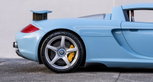
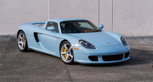
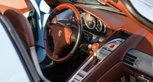
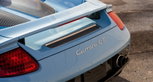
This history is perfectly captured by car number 0555, a 2005 model that stands out from the rest of the production run. While most Carrera GTs were painted in just five standard colors, this is the only example delivered to the United States in the historic Paint to Sample Gulf Blue. This light blue shade is legendary in the Porsche world, having been made famous by the 917 race cars that dominated Le Mans in the early 1970s. Paired with an Ascot Brown leather interior, this special paint color added 15.500 dollars to the original price, making it one of the rarest of the 644 cars sent to North America. This rare and distinctive specification explains the high auction estimate. With a range of 6 to 7 million dollars, it is about three times higher than the usual market value for a standard example.
Since it was first delivered, the car has been owned by only three private collectors and has spent most of its life in a climate-controlled environment in Florida. It has covered just 2.807 miles from new, and its condition is backed up by a full service history. In early 2026, the car received the important suspension recall service and was fitted with a new set of Michelin Pilot Sport Cup 2 tires, which were specially developed to optimize the car's handling. Complete with its original window sticker, manuals, and the matching Ascot Brown luggage set, this Gulf Blue Carrera GT is a unique piece of modern Porsche history.
 city-540560b2, 7 Mar