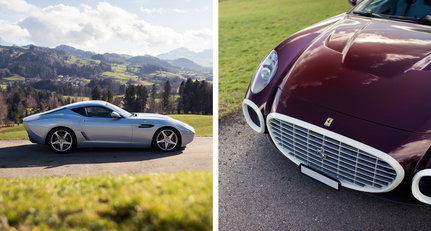







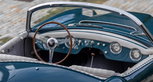

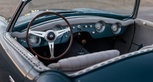




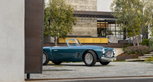
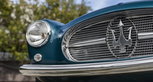
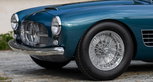


Not all cars are created equal, and one only has to look at the hundreds of brilliant minds dedicating thousands of hours to craft the next generation of concept cars to realise this fact. However, while today’s concepts are mostly static statements of design intent, back in the 1950s, they were far more functional machines, yet no less captivating. Today we uncover one of the era’s most incredible automobiles, notable for its one-off Zagato bodywork, first-of-its-kind engine, and incredible state of preservation today: introducing the 1954 Maserati A6G/54 Spyder by Zagato.


The 1950s was a pivotal era for the automobile. The challenges of war had taught Europe’s engineers the secrets of high performance combustion engines, while the world’s great designers and coachbuilders had yet to become obsessed with aerodynamics, meaning the era’s machines boasted an abundance of gorgeous hand-formed curves and dazzling chrome.
Just as Mercedes-Benz was distilling the essence of the 300 SLR into the one-off 'Uhlenhaut Coupé’, and Ferrari were crafting the jaw-dropping 375 MM Scaglietti Coupe for Italian director Roberto Rossellini, Maserati and Zagato were collaborating on an automobile that would go down in history as one of the era’s most spellbindingly beautiful machines.


Following on from the Frua-bodied A6G/54 2+2 concept introduced at the 1954 Turin Salon with the chassis number 2063, Maserati commenced a new numbering sequence with chassis number 2101, which happens to belong to the Spyder you see here. It was the first car to be fitted with the bleeding-edge dual-overhead cam inline six-cylinder engine, serving as a prototype for the run of 60 total examples of the A6G/54 produced by Michelotti, Frua, and Zagato.
However, while Frua would produce their own interoperation of an open-top A6G/54, chassis 2101 would be the only Spyder ever built by Zagato on the platform, while the Milanese firm’s coupe’s would eventually emerge as the driver’s choice for their aerodynamic, lightweight bodywork, which gave them a competitive edge over the more luxurious, grand touring-focused offerings from Frua.


According to marque authority Adolfo Orsi, chassis 2101 was commissioned by Argentinian president and world-renowned sports car enthusiast, Juan Perón, with build sheets revealing that the Spyder was sent to Zagato for its coachwork on 18 November 1954. However, Perón’s choice of the Trident wasn’t mere coincidence; at the time, fellow Argentine Juan Manuel Fangio had already rocketed to stardom by winning a world championship for Alfa Romeo in 1951, and by 1954 he was in the midst of his second year racing for Maserati. Like any avid motorsport fan, it seemed Perón wished for his ride to wear the same badge as the grand prix machine driven by the star putting Argentina on the map.
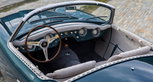
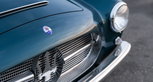
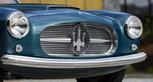
It is believed that Perón was present as chassis 2101 made its first public appearance at the Geneva Salon in March 1955, wearing Blu Algido Scuro paint over an interior upholstered in the equally luxurious and unusual Nubuck. Notable design flourishes specific to the Spyder at the time included a raked full-width one-piece windscreen, an unvented flat hood, unvented front fenders, and a wire-mesh grille complemented with fog lamps and an unusual, oversized Trident ornament.

Perón was clearly taken with the Spyder, affirming his intentions to purchase the unique show car, but the rapidly changing Argentinian political climate would soon see a revolt accompanied by Perón’s exile. It’s safe to say, the gorgeous Maserati Spyder was no longer among Perón’s top priorities. However, while the ex-president was no longer in a position to buy the car, this Spyder would reappear at the 1956 Paris Salon on the stand of Thepanier, the official Maserati importer to France, with numerous design adjustments made according to Perón’s wishes.
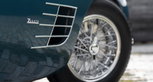
The most notable changes made to the Spyder ahead of its Paris Salon appearance include a smaller curved one-piece wraparound windscreen, a new hood with a raised engine intake scoop, elegant vented front fenders, and a new grille ornament with a more typical Trident badge. Following its public appearance, chassis 2101 was put into storage before being offered for sale in December 1958.
A few months later, an American diplomat working at the US embassy in Paris acquired the unique Spider, driving it to La Sarthe to watch the 1959 24 Hours of Le Mans shortly after, where he witnessed fellow American Carroll Shelby’s victory with the Aston Martin team. A year later, it was purchased by US Air Force lieutenant-colonel, Sherrod Santos, who commissioned a factory engine rebuild in 1962 that unfortunately wasn’t up to snuff and required further work from a French specialist. By November 1963, Santos had returned stateside to work at Langley Air Force Base in Virginia with the stylish Spyder in tow.


Colonel Santos sold the Maserati — then in a far less elegant shade of Rosso — in 1966 to George Sackman of Carmel, California, who kept the car until 1970 before selling it to Angelo Ferro, the Italian-American owner of the Genoa Racing Team. Ferro got very little use out of chassis 2101 before putting it into storage for a period of approximately 30 years. In 2001, it was finally brought out of stasis for a comprehensive restoration overseen by team chief Ed Nelson, including an engine rebuild by Ferrari specialist Paul Hasselgren, a repaint in the original factory color of Blu Algisto Scuro by Rob Etcheverry, and an interior retrim by Ken Nemineck.
After the completion of its restoration in 2003, chassis 2101 would enter the concours circuit at the 2003 Pebble Beach Concours d’Elegance, followed by another appearance at the 2004 Quail Motorsports Gathering, where it was awarded first place in the Post War Sports Car class. This Spyder’s run of accolades continued in 2005, when the car won Best of Show at Concorso Italiano, and multiple awards at the Palo Alto Concours d’Elegance. After participating in the Zagato display at the 2006 edition of the Quail, it was acquired in 2010 by UK-based collector Brandon Wang, with further notable appearances at the official opening of the Museo Casa Natale Enzo Ferrari, where it was the only Maserati invited to be shown at the new Enzo Ferrari museum, and at the 2013 Villa d’Este Concorso d’Eleganza to name just a few. In November 2013 it was sold at auction by Sotheby’s and what was then known as RM Auctions to well-known American collector Oscar Davis.

After Davis’ unfortunate passing, this Spyder was again offered by RM Sotheby’s in August 2022, when it was acquired by a respected collector based in Southern California, who decided to embark on the car’s very first no-expense-spared restoration. The owner entrusted the Spyder to one of the renowned specialists, Fast Cars Ltd of Redondo Beach, California, who diligently refurbished every chassis element, including brakes, suspension, and rear axle. Most importantly, the matching-numbers transmission was also rebuilt for the first time in its life.
As the final feather in this incredible Maserati’s cap (to date), following the completion of its restoration, it was shown at the 2024 Pebble Beach Concours d’Elegance, where it was awarded double honours, winning the special Maserati class and the Jules Heumann Special Award for the Most Elegant Open Car. Now RM Sotheby’s are offering this unparalleled Spyder for sale yet again, representing an unmissable opportunity to acquire what is undoubtedly one of the greatest machines ever to bear the Trident. Should you wish to take home honours at the next concours you attend, or simply steal looks from the world’s finest metal at any of the worlds premier vintage touring events, look no further than this Maserati A6G/54 Spyder Zagato.