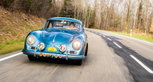
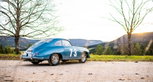
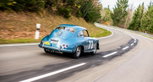
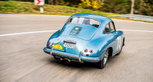

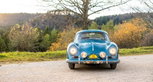





From the most famous Swedish rally of the 1950s, through decades of silence, back to the biggest stages of classic motoring: the history of this Porsche 356 A 1500 GS Carrera is extraordinary, multi-layered and deeply personal. It combines motorsport, contemporary and family history – and spans three generations of the Kaiser (in German: Emporer) family. This comeback was made possible by an uncompromising, meticulously detailed restoration at Boxer Motor & Classic Cars, which restored the almost 70-year-old Carrera not only technically but also historically to its immaculate original condition.


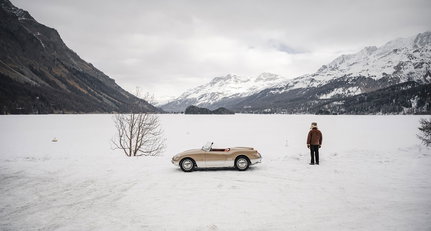
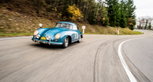
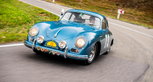
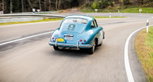
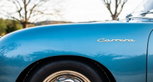
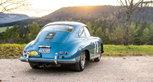
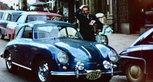
California in August 2025. On Highway 101, the famous coastal road along the Pacific Ocean, the Tour d'Elegance convoy sets off. It is one of the highlights of Monterey Car Week, when the automotive elite gather between Carmel, Pebble Beach and Laguna Seca. Amidst some of the most valuable and rarest classics, an aquamarine blue 1956 Porsche 356 A 1500 GS Carrera rolls along. The grey faux leather interior glows in the sun, the lines of the early Carrera seem timeless. At the wheel is Crister Kaiser. For him, this drive is much more than a social event. It is a journey into his own family history.
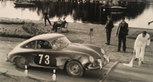
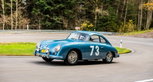
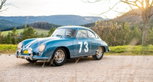
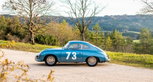
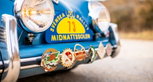
Because this particular car, with chassis number 55818, was once the workhorse of his father, Gert Kaiser. In the 1950s, the Swedish car dealer and amateur racing driver competed in this Porsche, winning races and representing Porsche in Scandinavia and beyond. The number 73 on the front of the car is not a decorative detail, but has historical significance. It refers to the 1956 Midnattssolsrallyt, the legendary Midnight Sun Rally, in which Gert Kaiser took third place in his class with this Carrera.

To understand this story, we have to go back a long way. Gert Kaiser was born in Berlin in 1925. Due to his Jewish heritage, his life was marked early on by the political upheavals of the Second World War. In 1939, his mother sent him alone to Sweden in the hope of saving him. His father, a dentist, had already fled to France years earlier, but the family was never to be reunited. Gert's mother remained in Germany and became a victim of the Holocaust. Upon arriving in Sweden, the 14-year-old initially spent time with a Jewish community before beginning to fend for himself with simple jobs. He found his first job as a delivery boy for a bakery, later even run his own bakery before starting to trade in cars in 1947.


Early on, Porsche emerged as the focus of his professional and personal interests. In the 1950s, Kaiser increasingly concentrated on the brand from Zuffenhausen. At the same time, he discovered motorsport as a stage on which to live out his passion. He was not a works driver, but an extremely ambitious amateur who earned respect through discipline, talent and technical understanding. His close contact with Ferry Porsche underscores this special relationship. A letter from 1953 documents how Ferry Porsche personally congratulated Kaiser on his second place in the class for production sports cars up to 1500 cubic centimetres at the Skarpnäck race.


Gert Kaiser personally picked up the Porsche 356 A 1500 GS Carrera with chassis number 55818 in Stuttgart on 21 March 1956. He was accompanied by his son, and the subsequent drive back to Sweden with customs plates was a memorable experience for both of them. These trips to Zuffenhausen were part of the family tradition. Once a year, they would drive to Stuttgart to pick up a new car or have a major service carried out. It was always a highlight for the boy, because Ferry Porsche always let him choose one model car from his collection.


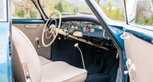
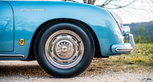
The fact that Kaiser did not plan the Carrera purely as a road car is evident from its original configuration. Ferry Porsche granted him a 25 per cent racing driver discount and six months' credit, a privilege he extended to dedicated amateur racing drivers. Instead of the standard Solex carburettors, Kaiser ordered Weber carburettors designed exclusively for racing. At the heart of the car was the famous 1500 GS engine, known as the Fuhrmann boxer, a technically highly complex unit with four camshafts connected by vertical shafts. The equipment was complemented by a speedster seat for the driver, special Dunlop racing tyres and stone guards for the headlights. For weight reasons, Kaiser even dispensed with a heater. He had the standard chrome-plated spoke wheels replaced with Rudge centre-lock wheels, not least to generate additional funds for racing by selling the original rims.

Gert Kaiser celebrated considerable success with this and other Porsche models. While he took second place in his class at the 1956 Mille Miglia in another 356 together with Max Nathan from Mainz, he achieved third place in the Midnattssolsrallyt shortly after delivery of the Carrera described here. In 1958, he drove a memorable race at the Berlin AVUS, leading until the final lap before being narrowly beaten by Huschke von Hanstein.
In 1959, Kaiser sold the Carrera to his friend Harald Kronegard, who continued to race the car in national events until the summer of that year. The Porsche then changed hands several times within Sweden. In the 1970s, it ended up in Germany, where it lost its original engine over time and eventually disappeared from view.


It was only after their father's death in 1999 that Crister Kaiser and his brother Staffan, two years his senior, began to take a closer interest in the whereabouts of their father's former Porsche racing cars. They reconstructed their history, collected documents and searched specifically for the vehicles. In 2016, they finally managed to locate the Carrera at a well-known Austrian Porsche classic car dealer. Its condition was sobering. The car was equipped with a later 356 C engine and had been heavily modified overall. For Niklas Schlagenhauf of Boxer Motor, it was a classic barn find.
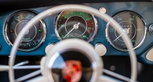
The reunion with the Kaiser family marked the beginning of a restoration project lasting several years, which was carried out by Boxer Motor & Klassische Automobile in Dotterhausen from 2017 to 2020. Unlike some projects, where large parts of the original substance are preserved, hardly any components of the Carrera 55818 remained untouched. Except for the steering wheel, every part was reworked, rebuilt or replaced. The original engine was no longer available, but through the mediation of Rolf Sprenger, known as long-standing head of Porsche’s “Sonderwunsch” department and author of the book “The Porsche Carrera Engine and the Early Years of Porsche Motorsport”, a period-correct four-camshaft Fuhrmann engine was procured. The overhaul of the highly complex unit was carried out by Karl Hloch from Waiblingen, one of the world's recognised specialists for this type of engine.


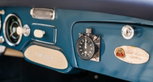
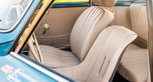
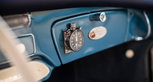
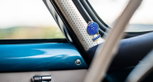
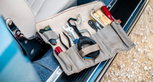
It was particularly pleasing that during the work, the correct Weber carburettors and matching air filters were found. The engine number is also extremely close to the original unit, with only 134 numbers separating them. This means that the drivetrain now corresponds exactly to the historical specification. When the car arrived at Boxer Motor, it was painted in a bluish silver tone. During the restoration, it was repainted in its correct exterior colour. The nose panel and rear were renewed, while the seat recess and centre tunnel were retained. The interior was completely rebuilt with light-coloured imitation leather, dark blue imitation leather on the upper part of the dashboard, a Speedster seat for the driver and the so-called slumber roll for the passenger. This cylindrical cushion is considered the precursor to modern headrests and was an innovative solution at the time.

Today, the Porsche once again corresponds exactly to the original 1956 specifications. The materials, colours and technology are authentic, nothing looks over-restored, and everything is functional and harmonious. For Crister Kaiser, the Carrera has long been more than just a collector's item. He has already entered it three times in the Mille Miglia with technical support from Boxer Motor, first together with his brother, later with his daughter Fanny in the passenger seat. This car now connects three generations of the Kaiser family. The next start is planned for 2027. Thanks to the continuous maintenance and care provided by Boxer Motor & Classic Cars, as well as the dedication of Crister Kaiser, the story of this unique Porsche is far from over.
Photos by Remi Dargegen for Classic Driver 2026. Pebble Beach image by B.Lockett