















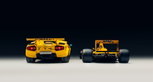











There are certain moments in motorsport history that feel almost cinematic in hindsight, where timing, ambition and engineering bravado come together to create something unforgettable. The Lamborghini-Lotus Type 102 Formula 1 car is one such moment, representing a brief but intoxicating chapter at the dawn of the 1990s, when Formula 1 was relieving itself of turbochargers, making way for naturally aspirated engines and allowing manufacturers to express themselves in ways that would soon become impossible. At the heart of this story sits a thunderous 3.5-litre Lamborghini V12, and around it a pair of cars that despite act differently when attached to tarmac, perfectly capture the very spirit of this smoking-hot era.

Lamborghini-Lotus Type 102
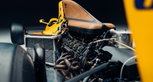
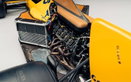
Turning the clock back the end of the 1980s, Formula 1 was in flux. Turbochargers, which had dominated the previous decade, were being phased out, and the rulebook once again favoured naturally aspirated engines. For Lamborghini, recently acquired by Chrysler at the time and eager to prove itself beyond the confines of exotic road cars, saw an opportunity with this regulation change. Sant’Agata Bolognese had built its reputation on V12 engines, after all, it was pretty much all they knew, from the Miura to the Countach, and so it became a natural move to lean into their strengths and produce a V12-powered F1 engine. The result, as you would expect, was a glorious sounding, high-revving beast, capable of outputting 640 horsepower and was developed using the same philosophy that underpinned its road-car powerplants.


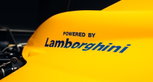
Lotus, meanwhile, was searching for a way to reassert itself in a rapidly evolving Formula 1 landscape. The partnership that emerged gave birth to the Type 102, a car that would forever stand apart in Lotus history as the only Formula 1 machine from the marque to be powered by a V12 engine, one from Lamborghini, no less. Introduced for the 1990 World Championship, the Lamborghini-Lotus Type 102 was innovative in both concept and execution, combining British chassis ingenuity with Italian mechanical prowess in a way that felt both daring and entirely appropriate for the time.
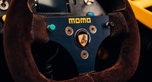
Over the course of its competitive life, the Type 102 would contest 37 races across three seasons, driven by a trio of notable names: Derek Warwick, Martin Donnelly and Johnny Herbert. Chassis number 02, the example at the heart of this collection, competed in six Grands Prix during the 1990 season, achieving its best result with an eighth-place finish at Imola and also taking to the narrow streets of Monaco, where its presence alone would have been worth the price of admission. This was an era of manual gearboxes, high-revving engines and cars that demanded commitment and bravery, and the Type 102 belongs firmly among the most evocative machines of that period.

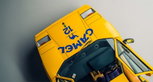
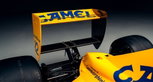
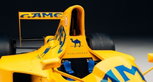
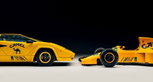
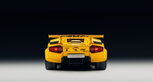
Visually, the car is every bit as compelling as its mechanical specification. The beautifully sculpted bodywork reflects an era when aerodynamics would become increasingly sophisticated, yet still allowed for elegance and proportion. Draped in the instantly recognisable yellow Camel livery, the Type 102 is unmistakable, a design that has become synonymous with both Lamborghini and Lotus during this period. Few colour schemes capture the spirit of late-80s and early-90s Formula 1 quite so perfectly, and fewer still are paired with a soundtrack as intoxicating as that of a Lamborghini V12.


Crucially, it was stored appropriately and sympathetically, preserving its originality rather than subjecting it to the sort of piecemeal restoration that can so often dilute a car’s authenticity. In more recent times, the car made a fitting return to its spiritual home, undergoing a complete mechanical restoration and recommissioning at Lamborghini Polo Storico. Carried out with factory oversight and attention to detail, this work is fully documented, with comprehensive records and imagery held on file, along with original period build and specification documents.
Today, the car would make an ideal candidate for historic racing events with minimal preparation, which the Furlonger workshop team have the expertise required to manage such a task, making the appeal of this new-age golden-era racer even more tantilising. We're seeing an influx of popularity around 1990s racers, and with rumours of Monaco Historique working on a grid specifically for this age of car, the time to invest and enjoy one of the sport's best eras truly is right now!

Just when you thought the story of this incredible machine couldn’t get any more cinematic, the Lamborghini-Lotus Type 102 has also found renewed relevance in popular culture, after being featured in the recently launched F1 Movie. Old timer racer Sonny Hayes, played by Brad Pitt, is depicted driving this very model during his fictional stint on the Formula 1 grid in 1990. In fact, the opening scene of the film features the Type 102 in action, filling the cinema halls with the unmistakable sound of the Lamborghini V12 and ensuring viewers remain locked-in for the entire movie!


Lamborghini Countach 5000 QV
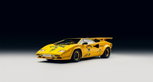
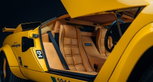
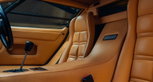
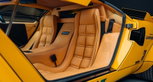
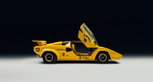
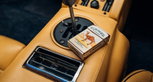
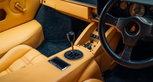
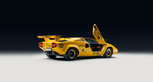
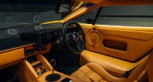
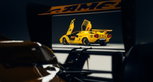
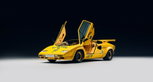
While the Formula 1 car is exceptional in its looks, historical importance and mechanical excellence, it’s appeal is only strengthened with the addition of a road-going counterpart that needs little introduction. This 1985 Lamborghini Countach 5000 QV, chassis number FLA12848 is an exceptional example, being the only right-hand-drive 5000 QV painted in Giallo from the factory, a shade that bears a remarkable resemblance to the yellow worn by the Type 102. That glorious Giallo is complimented by a Naturale leather interior, and comes complete with the optional rear wing, where the car was first delivered to its lucky owner based in the coastal region of Cornwall in the UK.

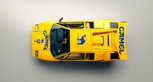
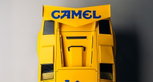
Enjoying long-term ownership for nearly three decades, from 1995 until its recent acquisition by Furlonger themselves, the Countach underwent a comprehensive mechanical recommissioning and extensive cosmetic refresh. Central to this work was a complete repaint in its original shade of Giallo, executed to an exceptional standard, where, in a visual homage to the Formula 1 car, the Countach is adorned with matching Camel decals and black wheels, creating a striking and cohesive pairing. Importantly, this livery is entirely reversible, with the original wheels retained and the option to return the car to full factory specification at any time.


Together, the Lamborghini-Lotus Type 102 and the Countach 5000 QV form a uniquely compelling proposition. One is a Grand Prix machine from Formula 1’s most evocative eras, the other is a road-going supercar that defined excess, ambition and drama in equal measure. Both are V12 Lamborghinis, both are finished in yellow, and both hail from a period increasingly regarded as the pinnacle of analogue performance, both are wildly different, and yet are connected in being different because they are so wild. We can't help but gaze off into the distance day-dreaming of driving the Giallo Countach along the Côte d'Azur, period-correct Persol sunglasses on and the muffled sounds of Eros Ramazzotti on the radio, only to park up alongside the matching F1 car sporting one of the world's greatest race liveries. The Camel Collection offers not just two exceptional cars, but a tangible connection to a time when motorsport and supercars were driven as much by emotion as by engineering, and while the modern world looks to hybrids and V6s, here are two icons shouting ‘long live the V12!’