


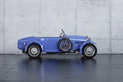


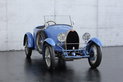


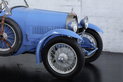


1930 Bugatti Type 40
Grand Sport-
Year of manufacture1930
-
Car typeConvertible / Roadster
-
Lot number161
-
Reference number1199
-
ConditionUsed
-
Location

-
Exterior colourOther

Description
One of only around 850 Type 40s built
Delivered in 1930 via the Vienna representative Oskar A. Stökler
Equipped with sporty Grand Sport bodywork
Owned by a single owner since 1954
Technically overhauled 15 years ago
Matching numbers
When Ettore Bugatti unveiled the Type 40 in June 1926, his brand was at the height of public attention. With the Type 35's major Grand Prix victories, the cars from Mulhouse were the talk of the town, and in the salons of high society, the elaborate luxury models from Alsace had become coveted status symbols. But Ettore was also a pragmatist: fame on the racetracks brought prestige, but the business had to survive on volume. And so the plan was born to create a Bugatti for those customers who could not afford a Royale, an eight-cylinder or a thoroughbred Type 35 – but still wanted to drive a Bugatti.
The Type 40 thus became the entry point into the Bugatti world. Technically, it was based on the successful racing car, but in a slimmed-down form. At its heart was a small but refined 1.5-litre inline four-cylinder engine from the small Grand Prix car, the Type 37. The overhead camshaft valve control, the fine workmanship, which was more reminiscent of a work of art than an engine, and the well-known smoothness of the mechanics made the engine far more than the mere 45 hp would suggest. After all, it allowed the Type 40 to reach speeds of over 120 km/h – more than enough for the country roads of the 1920s and fast enough to keep up with larger cars with confidence.
The chassis was classic Bugatti: a narrow ladder frame, rigid axles at the front and rear, transverse leaf springs. Purist, austere, but characterised by a lightness that made Bugatti's signature unmistakable. After a year, the wheelbase grew from 2,564 to 2,710 mm – still compact, manoeuvrable, a car for winding country roads and the French Route Nationale.
As was often the case with Bugatti, the Type 40 was not a series production model in the modern sense, but rather a chassis that customers could order with different bodies. Molsheim itself supplied simple two-seater bodies, often designed as roadsters or small tourers. In addition, elegant four-seater convertibles with light fabric tops, small coupés and, in individual cases, even sporty special bodies based on the appearance of Grand Prix cars were produced.
Particularly appealing was the Grand Sport, an open 2+1 version – two in the front, one in the rear – with a lower body and spartan cockpit, which was built by Bugatti itself. The racing spirit was immediately apparent here: the similarity to the Type 37 was hard to miss. Other buyers preferred the factory cabriolet, which brought a touch of grandeur to the small four-cylinder segment with its filigree lines and Bugatti elegance. The range extended from sober everyday cars to tailor-made one-offs for the driveways of Parisian city palaces.
Approximately 850 units were produced between 1926 and 1930, followed by a further 32 Type 40A models between 1930 and 1933, which featured a slightly larger bore and five more horsepower. For Bugatti, this was a remarkably high number. They made the Type 40 an economically important model – and the Bugatti that was actually driven most frequently. They were often the first Bugatti for young drivers, who later switched to larger eight-cylinder models.
Today, the Type 40 presents a fascinating contrast: once an entry-level model, but at the same time big on character. It shows that Ettore Bugatti's genius shone not only in the big things, but also in the small. Like every other Bugatti, the Type 40 embodies the spirit of Ettore: uncompromising, strong in character, timeless, always more than just an ordinary car – a work of art on wheels.
According to records from the Austrian Bugatti Club, this Bugatti, chassis 40721, a Grand Sport, was delivered on 30 March 1930 via the Vienna general representative for Austria and Yugoslavia, "Oskar A. Stökler", based at Pestalozzigasse 4 in Vienna's city centre. While its first owners are not known by name, a registration number has survived, in the form in which it was issued between 1938 and 1947. The individual approval from 1954 refers to an earlier registration, but does not mention any names.
From then on, however, the history of the Type 40 is quickly told. The Bugatti has actually only had one owner to date. A young man whose job title in the papers was "student". He had purchased the Type 40 for 1,500 schillings, later adding the remains of a Type 37, chassis 37201, for 2,000 schillings. So even in his early years, the man showed taste and a penchant for the extraordinary. There are a few photos from those years that show Vienna in the background, still scarred by the war.
The Type 40 spent most of the following decades in a garage on Krapfenwaldgasse in Vienna. In 1962, it took part in the International Bugatti Meeting in Diez a.d. Lahn, but otherwise it was hardly ever seen in public. From 2008 onwards, with both the driver and the Bugatti already at an advanced age, a new heyday began for the Type 40. With the help of a member of the Bugatti Club, the engine was completely overhauled and the car was converted to a dry clutch. Once the entire mechanics had been brought up to scratch, it was re-registered on 12 May 2010 – a little too late for the International Bugatti Meeting in Salzburg. Its owner took part in a meeting in Czechia in 2012, after which things quietened down again for the Type 40.
The last annual inspection expired four years ago, and the Bugatti has since outlived its owner. This unique automobile is now being passed on from his estate. Even today, the original engine with the number 691 still serves in the original chassis, on which the original Grand Sport body sits. You couldn't really ask for more from a Bugatti, but this one has so much more to offer with its extraordinary history.

Watch our latest videos
More Listings related to Bugatti Type 40

